


Roadworks - representing beware of the obstacles ahead of your business journey

Step 5: Choosing the right route

In business, guesswork won’t cut it. To grow, you need to spot the right opportunities and know which ones to leave alone. The better you understand your business and your customers, the easier it is to deliver real value and stand out from the competition.

Think of your business journey like a game of Snakes and Ladders.

Snakes and ladders - representing business opportunities and threats

Ladders are the good stuff: new trends, tech, or customer habits that give you a boost.
Snakes? Those are the unexpected changes—policy shifts, new competitors, rising costs—that could trip you up.

You don’t need a crystal ball, but you do need to pay attention to what’s happening outside your business bubble. Social, tech, economic, and political changes all have the power to help or hurt your progress.

Here’s the key: the more curious and informed you are, the better decisions you’ll make.

Let’s say you run a renewable energy company. Socially, you’re in a great spot; people care about sustainability. Technologically, solar panels keep getting better. Economically, energy costs are rising, making your offer more attractive. Politically, government support can be a game-changer, until it changes. That’s the kind of context you need to stay ahead of.

And it’s not just energy. The legal sector, retail, and even estate agents all have seen massive shifts in recent years due to tech, legislation, and changing consumer habits. The businesses that spotted the trends early adapted. The ones that didn’t? Many aren’t around anymore.

So, how do you future-proof your business?

Four practical steps:

  1. Watch the trends – What’s already happening in your sector that’s likely to continue?
  2. Consider different futures – What if the market shifts? What if it doesn’t? Build flexible strategies.
  3. Scan for signals – What new tech or behaviours are just starting to pop up? Early movers win.
  4. Shape your future – Don’t just react—act. Innovate, adapt, and focus on what makes your business better and different.

And here’s a bonus tip: standing for something, like sustainability or social responsibility, can be a real edge, even for small businesses. Customers and partners are more likely to choose businesses that share their values. Plus, it’s great for team morale and attracting top talent.

Future-proofing doesn’t have to be academic or overwhelming. It’s about being aware, staying curious, and making smart moves before you’re forced to.

Business Owners Guide to Business Growth

Next up in Step 6: We’ll turn the focus inward and look at how your internal resources can support the vision you’ve set. But for now, eyes on the road and don’t miss those ladders!

Footnote:

This post is part of the Business Owners Handbook, a 10-part blog series designed to guide SME business owners through the essential steps for sustainable growth and success.

Ready for the next step in your journey? Explore all 10 Steps and start building a business with purpose, direction, and real momentum. 

Book a complimentary discovery call

If you want to avoid the pitfalls of business growth, book a complimentary discovery call with one of our expert advisors.


Related Posts

Destination journey - the road ahead representing every business growth journey needs a robust plan.

Step 4: Defining Your Destination – Clarify Where Your Business Is Headed and Why It Matters

Create a Vision That Guides Growth and Inspires Action

Every successful business journey begins with a clear sense of direction. Step 4 in the Business Doctors 10-step process—Destination—focuses on defining your business vision, which is your ultimate, long-term goal. It is time to ask yourself the big question, ‘Where are we going?’

A business without a destination is like a ship without a compass. It might drift forward, but it’s unlikely to reach a meaningful or profitable shore. Defining your business vision is about taking control of your company’s future. It’s not just about dreaming—it’s about creating a strategic growth plan, inspiring your team, and making better decisions today that align with where you want to be tomorrow.

Why a Business Vision Matters

Your business vision is your long-term aspiration. It’s the big-picture goal that keeps you and your team focused and motivated. Whether you’re a startup or an established business, having a defined destination sets the tone for everything else: operations, recruitment, marketing, investment, and even your exit strategy.

Without a vision, your business can easily become reactive, responding to problems as they arise rather than proactively building toward something greater. With a strong vision, however, you operate with purpose. You know what you’re trying to build, and that knowledge shapes your decisions at every level.

Think Big, Act Bold

A compelling business vision should stretch you—it isn’t the place for modest targets. This is where you imagine the biggest version of your business. If you currently turn over £1 million annually. Could that be £7 million in five years? More?

The best business visions are:

  • Aspirational – they excite and inspire
  • Believable – can realistically be achieved with the right effort and planning
  • Strategic – they provide a framework for decision-making
  • Shared – they’re understood and embraced by your entire team

Big visions change how you think. When you begin planning around your future company—not your current one—you start to make decisions that move you toward that destination. 

Live the Vision Every Day

A business vision should not be written down and then forgotten. Every action, investment, hire, and conversation should be filtered through the lens of your long-term vision.

For example, imagine your five-year goal is to grow to £7 million turnover. What would that version of your business look like? Ask yourself:

  • How many staff members would we need—and what roles would they fill?
  • What kind of leaders will be essential?
  • What systems, tools, and technologies would support this growth?
  • What physical space or locations will we operate from?
  • What kind of customer service will we deliver?
  • Who will our strategic partners be?

Thinking in this way allows you to reverse-engineer your journey. It turns a lofty vision into actionable steps.

Structure Follows Strategy

Growing a business doesn’t mean scaling everything proportionally. A company going from £1 million to £7 million turnover doesn’t necessarily need seven times the staff or office space. In many cases, increased efficiency, better systems, and smarter delegation can achieve that growth with relatively lean changes.

But you will need to think differently about structure. You may need:

  • A more developed leadership team
  • Stronger financial oversight
  • Dedicated sales and marketing personnel
  • Scalable operations
  • HR and legal support
  • Advanced IT systems

The point is that growth requires planning, and planning begins with a clear vision. You don’t build a £7 million company with £1 million’s worth of thinking.

Avoiding the Growth Trap

Many business owners get stuck in the day-to-day. They know they want to grow, but they don’t take the time to think about what that looks like in practical terms. They chase opportunities without a plan, solve problems without a strategy, and build teams without a structure.

Without a clear destination, it’s easy to plateau.

But when you have a vision, the fog starts to lift. Your strategic planning becomes sharper. You say “yes” to the right things and confidently say “no” to the distractions. You become proactive, not reactive—and that’s when real progress begins.

Start Today – Build Toward the Future

Business Owners Guide to Business Growth

If this is the first time you’re thinking about your business vision, don’t be overwhelmed. The process begins with a single step: writing it down.

Begin by visualising your business five or ten years from now. What are you proud of? What have you built? Who have you helped? Then work backwards. What would have to happen in the next 12 months to be on track?

And remember, no great business is built overnight. But by identifying your destination now, you dramatically increase your chances of getting there—and you’ll enjoy a far more focused and fulfilling journey along the way.

Key Takeaways:

  • A business vision is your long-term destination—it gives your company direction and purpose.
  • Think big, but keep it believable. Vision is only powerful if it inspires action.
  • Start planning today as if you’ve already reached your goal.
  • Structure your business to grow toward your destination—systems, leadership, and strategy all matter.
  • Let your vision shape everyday decisions—it will guide relationships, investments, and culture.

The earlier you define your destination, the sooner you begin to move meaningfully toward it.

Other posts on the topic of Vision:

Business Vision, Mission and Values – Why are they so important?

Does not having a business mission and vision hinder growth?

Footnote:

This post is part of the Business Owners Handbook – a 10-part blog series designed to guide SME business owners through the essential steps for sustainable growth and success.

Ready for the next step in your journey?
Explore all 10 Steps and start building a business with purpose, direction, and real momentum.

Book a complimentary discovery call

If you want to avoid the pitfalls of business growth, book a complimentary discovery call with one of our expert advisors.
Related Posts

Business Woman at computer representing Figuring out your purpose - why your business exists in the first place.

Step 3: What's driving you?

In today’s fast-paced world, it’s easy to get caught up in what we sell, make, or deliver. But in doing so, we often lose sight of the deeper value we bring—the problems we solve, the lives we touch, and the legacy we aim to leave behind.

It’s time to start thinking more deeply about your customers.

Every business must deliver results. However, we often lose sight of who our customers are and what they truly need. Just because they’re spending with you doesn’t mean you’ve got it right.

“A company’s purpose goes beyond financial results; a company with a clearly defined purpose is more likely to experience growth, achieve greater customer satisfaction and retain talent.

More Than What You Do—Focus on Why You Do It

It’s natural to define your business by your products or services. But the real driver of lasting impact is your purpose—the reason you exist beyond profit.

Purpose is more than a slogan. It’s your organisation’s heartbeat.

Ask yourself:

  • What are your customers really buying from you?
  • What do you offer that others don’t—or can’t?
  • Are their needs and motivations evolving?
  • Are you still serving those needs as effectively as ever?

Too often, businesses focus solely on their offerings, overlooking the real reasons customers choose them.

The Power of Purpose

A strong purpose drives performance on every level. Here’s how:

Growth

According to Harvard Business Review:

  • 58% of purpose-driven companies achieved over 10% growth in the past three years.
  • Only 42% of companies without a clear purpose reached similar growth. 

Innovation & Transformation

From research by EY and the World Economic Forum:

  • 53% of leaders at purpose-led companies say they excel at innovation.
  • Just 19% of leaders in companies without purpose say the same. 

Attracting Top Talent

A Deloitte survey found:

  • 62% of job seekers consider a company’s purpose before accepting a role.
  • 36% rank purpose as equally important as salary and benefits.

Customer Loyalty & Employee Satisfaction

From Harvard Business Review:

  • 89% of executives believe purpose boosts employee satisfaction.
  • 80% say it increases customer loyalty.
  • 84% believe it enhances their ability to adapt and transform.

Health & Well-being Benefits

It’s not just about business. It’s personal. Forbes reports people with a strong sense of purpose:

  • Have a lower risk of cardiovascular disease
  • Experience less loneliness
  • Make better lifestyle choices
  • Even live longer

How to Establish and Activate Purpose in Your Business

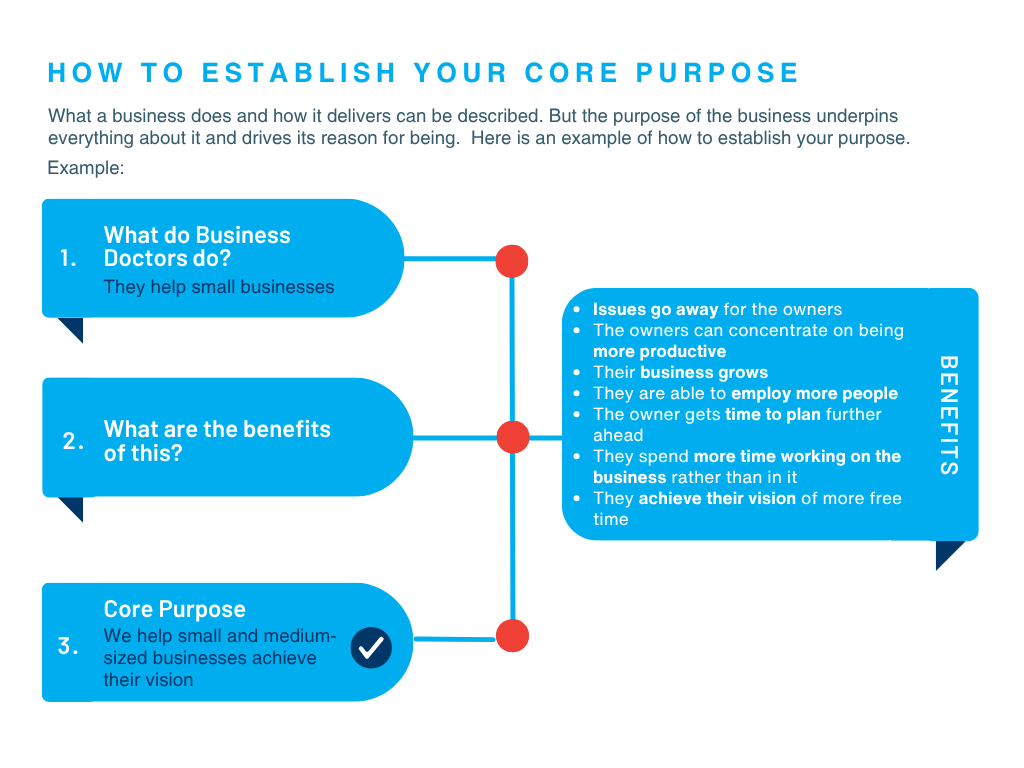
Finding your purpose: Example from Business Doctors

Here’s a practical roadmap to bring purpose to life:

  1. Discover Your Why – What motivates you? What impact do you want to make?
  2. Put It in Writing – Make your purpose visible and foundational to decision-making.
  3. Revisit Regularly – Let it evolve as your business grows.
  4. Engage Your Team – Involve everyone in shaping and owning it.
  5. Live It Daily – Let purpose influence how you hire, reward, innovate, and operate.
  6. Share the Story – Communicate your purpose clearly to customers, partners, and suppliers.
  7. Apply the “Janitor Test” – Make sure every employee, from the CEO to the cleaner, understands how their role contributes to the bigger picture.

Remember the story of JFK visiting NASA? When he asked a janitor what he was doing, the reply was: “I’m helping put a man on the moon.” That’s purpose in action.

By anchoring your business in a clear, authentic purpose, you don’t just grow—you create meaning, momentum, and a lasting legacy.

Business Owners Guide to Business Growth

All new cars come with a handbook to help you navigate the vehicle’s functions, but owning and reading the manual doesn’t instantly make you a mechanic. If you want a Business Doctor to guide you on your business growth journey, please talk to us.

Reference: Breaking Big – The Business Doctors’ no-nonsense guide to achieving breakthrough growth for your business.

Footnote:

This post is part of the Business Owners Handbook – a 10-part blog series designed to guide SME business owners through the essential steps for sustainable growth and success.

Ready for the next step in your journey?
Explore all 10 Steps and start building a business with purpose, direction, and real momentum. 

Book a complimentary discovery call

If you want to avoid the pitfalls of business growth, book a complimentary discovery call with one of our expert advisors.

Related Posts

Driving your values, image of sunrise from rear view mirror representing a business growth journey

Step 2: Driving Your Business Values

Many would-be business owners feel the pull to start their own venture, not just because of the product or service they want to offer, but because of the kind of company they want to build. A place where people genuinely enjoy showing up every day, where the values aren’t just words on a wall, and where the culture feels right.

Even if you haven’t consciously dwelled on it, your values have likely played a role throughout your career. They’ve shaped your decisions, leadership style, and the environments you’ve gravitated toward (or avoided). If you’ve ever left a role because something didn’t feel right, chances are, there was a misalignment in values. 

Why Values Matter So Much

Values are the oxygen that runs through a business, but as teams grow and the day-to-day tasks become more demanding, it’s all too easy for that oxygen to get diluted — or even depleted. When that happens, performance often slips. People disengage. Culture drifts.

When Culture Goes Off Course

Have you ever had a Monday when a high-performing employee unexpectedly quits? Or where multiple team members seem slow, unmotivated, and late? These aren’t just performance issues — they’re often signs that your culture is out of sync.

As a business grows, the founder’s original values can fade into the background — unintentionally. The result is a slow erosion of the environment you set out to create.

So, how do you get back on track?

Back to basics —get a little selfish

That may sound counterintuitive, even wrong. After all, running a business often means prioritising everyone but yourself: your employees, your customers, and your suppliers. Many founders find themselves working long hours, paying their team well, and taking little home themselves.

But here’s the truth: a strong, aligned culture starts with you. In the early days, your vision was the guiding light. Your values shaped the decisions, the vibe, and the mission. Over time, as more people came on board and new challenges emerged, that clarity might have become diluted. It’s understandable — but it’s not irreversible.

“In order to carry a positive action, we must develop here a positive vision” Dalai Lama

Taking a moment to reconnect with your original intention — the kind of business you wanted to build, the kind of place you would want to work — is not just healthy. It’s essential.

Reclaiming clarity starts with you. This kind of “selfishness” isn’t about ego — it’s about reconnecting with your original vision and using it as a filter for every decision in the future.

Ask yourself:

What kind of business do you want to build?

Are your teams behaving with customers and suppliers in a similar way to how you did when you did that role?

What do you want this company to stand for?

What kind of people do you want to work with and serve?

When you lead with that clarity, others will follow. 

Your People: Culture Starts from Within

Employees will always take a cue from leadership, so keeping values front and centre is critical.

Ask yourself:

Are you hiring for values, not just skills?

Do your interview questions surface candidates’ core beliefs?

Do your performance reviews assess alignment with company values, and reward it?

Are your team members empowered to make decisions based on those values?

Do you model those values in your leadership?

If the team doesn’t live and breathe your values, you’ll struggle to create the kind of culture you envisioned, and retention, engagement, and performance will all suffer.

Your Customers: Shared Values Build Loyalty

Values don’t just matter internally — they also matter in your customer relationships.

Are your customers aligned with your values?

Are your sales team focused on fit or just closing any sale?

Do some customers continually push for price cuts while expecting premium service? That’s a clash of values — and a long-term threat to your sustainability.

Have you asked your customers what matters to them?

Do you measure satisfaction based on the right things that reflect your values?

For example, you might think it’s next-day delivery, but your customers might value accuracy more, because it reduces their internal workload.

And finally:

Are you rewarding your team for upholding your values, not just hitting numbers? 

Your Mission: Purpose Powers Progress

Your mission is the “why” behind it all — the purpose that unites your team and tells the world what you’re here to do.

Unlike your vision (where you’re going) and your values (how you’ll behave), your mission defines your impact: What difference do you want to make in your industry, community, or customers’ lives?

Ask yourself:

Does your mission still reflect your current ambitions?

Can every team member clearly explain your mission?

Is your mission guiding priorities, investments, and everyday actions?

A clear, authentic mission gives meaning to work. It motivates people beyond payday. And when shared openly, it attracts like-minded customers and partners who believe in the same thing.

Vision, Values, and Mission Aren't Just for Show

Vision, Values, and Mission are the backbone of any successful business. They provide direction when things get busy. They help with hiring, managing, and even letting people go. And most importantly, they help create a culture where people want to stay.

Final Thoughts: Realign, Reconnect, Reenergise

When you lose sight of your values and vision, you risk more than just a misaligned team — you invite disengagement, poor morale, and unhappy customers. That’s why it’s time to get intentional — even a little selfish. Reconnect with the vision that sparked it all. Live and breathe your values. Lead by example. Because when your purpose is clear and your people are aligned, you don’t just build culture — you build momentum, trust, and lasting success.

📘 Want to drive a successful business?

Download our free Business Owners Handbook for practical advice on how to embed your vision and values into every part of your company.

Download Now

Business Owners Guide to Business Growth

Footnote:

This post is part of the Business Owners Handbook – a 10-part blog series designed to guide SME business owners through the essential steps for sustainable growth and success.

Ready for the next step in your journey?
Explore all 10 Steps and start building a business with purpose, direction, and real momentum. 

Book a complimentary discovery call

If you want to avoid the pitfalls of business growth, book a complimentary discovery call with one of our expert advisors.

Related Posts

Business Doctors Matt Levington, and Graham Robson with One By Uspire Partners welcoming new Business Doctor Alastair Beveridge

With over 25 years of experience leading transformation in major global organisations, Alastair Beveridge is excited to announce the launch of his new venture as a Business Doctor. In this role, he will work with business owners in Bath, South Gloucestershire, and West Wiltshire to unlock growth, navigate challenges, and help them realise their commercial goals and personal aspirations.

Alastair’s impressive career includes senior roles at Zurich, Ernst & Young and AXA UK, where he served as a Programme Director and strategic change leader. Drawing on this deep expertise, he brings a rare combination of analytical rigour, real-world business insight, and a passion for practical, results-driven solutions.

“My mission as a Business Doctor is to help local business owners grow their businesses and fulfil their aspirations—whether that’s scaling operations, improving profitability, or simply giving them more freedom to enjoy the life they have built,” said Alastair. “I will be working closely with them to uncover the real challenges and help put in place steps to help them move forward with confidence.”

Alastair thrives on solving critical business problems, helping owners reset, refocus, and move forward with clarity. His approach is collaborative and grounded in the reality of running a business, offering practical strategies tailored to each unique situation.

“Alastair has the perfect blend of experience and humility that we look for in a Business Doctor, and we are delighted to welcome him to our growing team,” said Matthew Levington (managing director).

Outside of his professional work, Alastair is a dedicated supporter of grassroots sport. He spends his spare time coaching a youth rugby team and supporting a junior cycling team, championing the role sport plays in building stronger, healthier communities.

Business owners seeking to navigate challenges, scale their operations, or gain a fresh perspective are encouraged to connect with Alastair for an introductory consultation.

Business Doctors launched in the Northwest of England two decades ago and now has offices in Bulgaria, Belgium, India, the Republic of Ireland, Malta, the Middle East, Myanmar, Portugal and South Africa.

Book a complimentary discovery call

If you want to avoid the pitfalls of business growth, book a complimentary discovery call with one of our expert advisors.

Related Posts

Personal Aspirations: Business Man at laptop with dog by his side.

Step 1: Your Business Growth Journey

Part One of our Business Owners Handbook is to figure out where you are going. Your business growth journey starts here. It’s time to stop firefighting and get inspired again. Remind yourself why you started your business in the first place and set your personal aspirations.

Like most business leaders, you probably know your business inside out, having immersed yourself in the minutiae of its day-to-day challenges for many years.

But when you are dealing with immediate operational issues daily, there is rarely a moment to step away from all the noise and activity to take stock of what’s happening in a more considered way.

Is what you are doing day-to-day working? Are you utilising your talents, know-how, and relationships effectively? Are you keeping yourself energised and happy? These are all great questions to ask yourself. After all, most people start businesses because they want to, not because they need to, and because they have been inspired by a dream or a big idea.

This article is designed to persuade you to take some time out to remind yourself why you started your business in the first place, what the positives of owning your own business are, and to pause and think about where you would like your business to be.

“Our aspirations are what drive us to do our best. Being honest with ourselves and identifying what we’d like to improve can lead to personal growth and new opportunities we wouldn’t have reached otherwise.” Effective Goal Setting – Forbes.

Many of us lose sight of our personal goals when we continuously focus on achieving business objectives rather than our own.

My wife is constantly reminding me, ‘What’s the point of climbing a mountain if you don’t stop on the way up, turn around, and enjoy the view? ‘

Therefore, in this respect, it’s time to take a step back and focus on your personal aspirations.

Your business is an incredible resource for achieving these goals – use it to your advantage.

“If you always do what you’ve always done, you’ll always get what you’ve always got.” Henry Ford.

With this in mind, I wanted to share some of my insights to help you aim high and realise your dreams.

Your personal aspirations will affect your business

Mountain Climbing:Man on top of cliff representing - endless business opportunities

Be as creative as you want when it comes to working out what exciting looks like. The point is, we can all agree that it’s only once you know what truly gets you excited that you can plan for the same. This is not a business aspiration, but a personal goal.

For a business owner in their 50s or 60s, the thought of spending more time with grandchildren on the golf course or travelling might be appealing, or starting a new hobby, or passing the business on so there is a legacy to be remembered by – maybe that’s what they want.

For a younger business owner who has established a business, they may have a desire to:

  • Make the world a better place
  • Have a business that supports an enviable external lifestyle
  • Make sufficient money to indulge in fun projects
  • Become a nationally known brand.

Whatever your aspiration is, it will have an impact on the structure of your business and the way you manage it.

There is nothing wrong with being selfish about your dreams, as long as other people in the business are made aware of your intentions and the business makes the necessary plans to accommodate the changes.

It could be a memorable extended holiday in India that you yearn for with your partner, or having more time off each week to spend with family. Perhaps it’s a new car, a skiing trip with friends this winter, or even a holiday home.

For me, it’s achieving early retirement, then spending time travelling with my wife and conquering some more Wainwrights and Munros while I’m still fit enough to do so.

Are you building a large enough pension pot to allow you to draw down some income before reaching the state pension age, and can you wait that long and to that age to fulfil your aspirations?

Ultimately, to achieve most of the things you want in life, you will need money to live on and to treat yourself. In simplistic terms, owning a business is about putting money in the bank.

Assign a monetary value to your goals.

Ensure that you are always focused and working towards your personal aspirations and put a number on it, e.g. a holiday £6,000, a car £24,000 or a holiday home £250,000.

Break this overall monetary value into sizable chunks, such as by month, over the period you have set.

For instance, if you need to generate an extra £1,000 net profit per month from your business over the next 24 months to buy that new car, set yourself a target of £1,200 per month.

Then stretch this monetary target; it’s always wise to stretch this monetary target by 10-20 per cent. By setting a stretched target, you may well achieve your goal early.

That first month, when you achieve the £1,200 extra income, the self-gratification and sense of achievement will make you step back again and then take the necessary steps to challenge and change things even more. Now the big wheel is turning, and achieving £1,250 per month becomes a new personal objective, thereby creating further appetite for change.

Set realistic timescales to achieve your goals.

Set yourself a realistic timescale to achieve your personal goal. Will it take three, five or even 10 years to achieve? Ensure the target is realistic, and by stretching it marginally, you are likely to challenge yourself to step back, reflect on yourself, adapt, and approach things differently. It’s about working smarter, rather than harder.

I’m currently supporting a business owner who has set a five-year plan to exit his business and retire. We are 18 months in and are realistically ahead of schedule by a good year.

Interestingly, as he can see the end in sight, he is eager to accelerate the progress.

Visualise your dream

Visualise your dream: business woman walking in a meadow

Visualise your dream. Have a picture of your dream on the office wall, fridge door or screen saver on your phone or computer. Keep believing this dream is within reach and sense the feeling of achievement!

“Business Doctors has given me the confidence to try new ideas, step out of the day-to-day routine and get excited about the future instead of being despondent.” Stacey Dunne, Owner of Hartpury Saddlery.

Imagine your personal goal is within reach, and keep sensing the feeling of achievement.

This will help you focus on the tasks at hand and remind you why you’re working long hours and why you’re going through any pain to achieve your goals.

Now that would be a great feeling and sense of achievement! You have a target and the determination to achieve it.

Ultimately, it is your employees who will deliver your objectives and therefore help you to achieve your personal aspiration.

At some point, you may even step away from the day-to-day earlier than you had originally planned and get to the top of that mountain earlier than anticipated.

One important thing to note is that you do need to achieve a balanced approach.

If your dream and target are too easy to achieve, you will never push yourself to drive change. In contrast, if the goal is too stretched and unrealistic, the chances are that you may even give up.

To add, my client’s business is currently generating 18 per cent more revenue and 22 per cent more profit than when we began planning, enabling him to recruit the best talent available and refine his systems and processes.

Our next step is to find his replacement and then begin to hand over and wind down his duties, allowing him to achieve his personal goals.

“Achieving a goal is nothing. The getting there is everything. Jules Michelet

If you would like some help considering what changes need to be made in your business, so your current aspiration can be achieved, book a complimentary discovery session with your local Business Doctor.

Footnote:

This post is part of the Business Owners Handbook – a 10-part blog series designed to guide SME business owners through the essential steps for sustainable growth and success.

Ready for the next step in your journey?
Explore all 10 Steps and start building a business with purpose, direction, and real momentum.

Book a complimentary discovery call

If you want to avoid the pitfalls of business growth, book a complimentary discovery call with one of our expert advisors.

Related Posts

Uspire Leadership Team and Business Doctors Coaches and Trainers in action

Uspire Partnership and Business Doctors join forces to empower Business Growth and Leadership Development.

The Uspire Partnership, a sales and marketing training leader, and Business Doctors, a renowned provider of hands-on business support for SMEs, announce a new strategic partnership.

By combining expertise, they will offer an even broader range of leadership development, business strategy, training, and coaching services, helping businesses of all sizes accelerate growth, navigate change, and build future-ready teams.

What This Partnership Means For Clients

Looking ahead, this partnership unlocks exciting opportunities. By combining expertise, they can offer an even broader range of resources, insights, and strategic development solutions. Whether supporting SMEs with hands-on business growth or helping corporate enterprises enhance leadership excellence, this collaboration means more value, expertise, and more significant opportunities for success.

A Partnership Built on Expertise and Shared Values

Initially founded in 2010 by Mark Francis and Jonathan Brough, The Uspire Partnership has successfully trained over 4,500 delegates across 14 countries, specialising in sales and marketing training for mid-sized and corporate businesses in industries such as FMCG, food retail, financial services, technology, and pharmaceuticals. Their mission is still to create the finest commercial leaders in the world, energising them with the skills and confidence to thrive in a competitive marketplace.

Business Doctors was founded in 2004 by Matthew Levington and Rod Davies. For the last two decades, the organisation has been helping small and medium-sized enterprises overcome challenges, scale effectively, and achieve long-term success. With a well-established franchise network across the UK and internationally, they provide affordable, hands-on business guidance tailored to entrepreneurs’ needs.

Bringing Businesses Together for Greater Impact

A key focus of this partnership will be the growth of Uspire’s membership programme, The Network, which will strengthen Business Doctors’ extensive regional footprint. Additionally, Uspire’s corporate clients will have access to Business Doctors’ proven 10-step strategic programme, offering a structured approach to business growth and resilience.

This collaboration will create a dynamic learning community, connecting business leaders across sectors. By fostering knowledge-sharing between SMEs, mid-sized companies, and large enterprises, they aim to provide fresh insights, innovative solutions, and new growth opportunities.

“Our partnership with Business Doctors is a natural fit,” said Pippa Dunford, Managing Partner of The Uspire Partnership. “We share a common vision of providing a safe space for businesses, teams, individuals, and leaders to develop and thrive, whether through face-to-face interactions or online platforms.”

Matthew Levington, co-founder of Business Doctors, echoed this sentiment: “Together, we are committed to building and inspiring confidence in people to lead and navigate change, ensuring they are equipped with the tools and strategies needed to succeed in today’s competitive landscape.”

Both organisations have undergone significant transformation in recent years, adapting to the challenges of an evolving business landscape. By joining forces, they are committed to delivering an even more robust suite of services, helping leaders, teams, and businesses develop, adapt, and succeed in an ever-changing world.

Please get in touch if you have any questions regarding this announcement.

Book a complimentary discovery call

If you want to avoid the pitfalls of business growth, book a complimentary discovery call with one of our expert advisors.

Related Posts

The Business Doctors Business Owners Handbook

Your business - your opportunities

Whether you are a serial entrepreneur or following your dream of being your own boss, the simple truth is that running a business has its challenges, and being the boss can be a lonely place to be.

The buck stops with you; you are expected to have all the answers.

  • Where are all the good people to be found?
  • When you do find them, why are they so expensive?
  • Who can you trust?
  • Why aren’t you making any money again this month?
  • How did you lose your key customer?
  • Who do you turn to when facing a critical decision or when your market shifts and you need to change how you operate?

No one individual has all the answers – at Business Doctors, we firmly believe that successful business is rooted in sharing experiences and knowledge without expectation of reward or return, and that is why we have written the business owners handbook to help guide you on your business growth journey and help you future-proof your business. 

Business growth pains: death by chocolate

Death by chocolate, represented by chocolate cup cakes and RIP sign.

Imagine you own a chocolate business. In the early days, life is sweet. You introduce three luxury chocolate products and start selling them through a network of high-end gift and chocolate retailers.

Buoyed by your early success, you later invest in selling directly – through a dedicated e-commerce website and a network of retail outlets you establish across the UK. You also branch out from your luxury chocolate range into middle- and mass-market products, eyeing the prospect of supermarket sales and more.

However, as the company grows and the opportunities keep popping up, the challenges multiply, too. Cocoa prices and the cost of other raw ingredients keep on rising, squeezing margins, while the complexities of producing dozens of confectionary products from a single manufacturing site for a growing number of customers with different expectations and cultures and overseeing dozens of retail branches across the country with all the staffing and property-related challenges that go with it starts to take its toll.

There is competition now coming from all directions, too, as others have moved in on the market niche you first identified and have undercut you in terms of price. Suddenly, things are not so rosy.

What to do? While most business owners might carry on working with the logic of the business they have created, distracted by cash flow, staff, customers, and all those other things, it is hard to plan for in business; really, what’s needed is a root-and-branch rethink.

Many SMEs find themselves here, and the answer isn’t always straightforward.

Budget-oriented or forecast-based planning methods are insufficient in today’s highly competitive business environment. To survive and prosper, you will need to engage in strategic planning that clearly defines your objectives and assesses both the internal and external situation to formulate strategy, implement the strategy, evaluate your progress, and adjust as necessary to stay on track.

We will guide you through this process. Our SME owner’s handbook is designed to address all these issues and give you a clear action plan to address each one. To succeed, we will help you go on a journey of discovery and work out what matters. 

PART ONE: FIGURE OUT WHERE YOU ARE GOING

Your business growth journey starts here!

PART ONE: FIGURE OUT WHERE YOU ARE GOING

Take the time to remind yourself why you started your business in the first place.

Are you:

A restless serial entrepreneur who spends your life spotting opportunities and going after the best of them.

Following a vocation – perhaps because the prospects for doing so are better than the prospect of working for others for years to come.

An accidental entrepreneur forced by circumstance to pursue opportunities on a self-employed basis (maybe because of redundancy) has forged a business over time.

Despite your reasons, there’s a good chance that you were excited by creating your business and by its development at various points along the way. But what about right now? Is the excitement and passion still there? Or does work frequently become a stressful obligation and a chore?

Before you embark on your business growth journey, it’s worth reminding yourself about the positives of owning your business and thinking about where you would like the business to be. Next, you will need a plan for getting there. 

Driving your business values

The importance of having a clear vision, mission and values is grossly underestimated, especially within the SME community.

When a business has a compelling vision and a clear, worthwhile mission, its owners and stakeholders will be genuinely inspired, staff will be motivated, and customers will want to do business with it;. This is what makes your business tick!

Driving values in a business is more than posting a mission statement on the wall, website, and in the new-starters pack for employees. Your business values must be embraced by every person in it, starting with you, your leadership team, and every staff member,

Once you are set on what you stand for, communicate this effectively to everyone within the business and externally to customers, suppliers, and the media. This will ensure consistency and cement your culture.

More information on business culture can be found in our article Vision mission and values and why they are so important.

Purpose: What is driving you?

It’s so easy for us to focus on what we make, sell, or provide that we sometimes forget to consider our actual value—in other words, what problems we solve for our customers.

“A Deloitte survey of over 4,000 respondents* found that over half of employees (62%) consider an organisation’s purpose before deciding to join, with over a third (36%) saying that an organisation’s purpose was just as essential as their salary and benefits package.”

It’s often easier to describe your business in terms of what you do or how you do it. But can you clearly articulate why you do it?

What difference do you make to your customers, what are they buying from you, and why are they buying it from you?

Business purpose is an essential concept for building a successful and sustainable company. It provides direction and focus for the organisation, helps differentiate the company from its competitors, attracts and retains top talent, and builds a strong reputation in the market.

If your team know your purpose, they can be 100% focused and at maximum efficiency. If suppliers know your purpose, they can focus on giving you exactly what you need regarding products and services. If customers know your purpose, they are more likely to provide you with all the orders for your essential products and services.

The purpose of your business should underpin everything about it and drive its reason for being.

More on purpose can be found in our previous article What is business purpose and why is it important

Roadmap: Where is your business heading?

Long-term business vision

Although it may be difficult to think about the future when so much is happening here and now, it’s important to set out a longer-term aspiration and ambition for what you see the business achieving and becoming.

A vision is the best way to get your business moving in the right direction, regardless of others’ pessimism or lack of ambition.

No one could ever accuse Facebook’s Mark Zuckerberg of lacking a vision or some cast-iron self-belief, and look where Facebook is today.

Your milestone or visionary goal should be more challenging than the strategic or tactical goals you may already have in place. Think big; if you do, you can potentially transform your business.

PART TWO: PLAN YOUR ROUTE

Avoid roadblocks: choose the right lane

Once you have established your destination (vision), you will need to look out for any external situations and events that could affect your progress. Using the travel analogy, before embarking on a long journey, you would check your tyres, fill the tank, plan your route, and check for any traffic issues along the way.

Think snakes and ladders

Snakes and Ladders, representing obstacles and opportunities

Like in the children’s board game, ladders refer to any opportunities that could help jump-start your business with new areas for sales or improve profit margins. Snakes, meanwhile, are those changes in the social, technological, economic and political (STEP) that might restrict your business in some way, by taking away the problem your business was solving or by introducing competition that may radically cut or even remove your margins.

This process is also referred to as STEP Analysis. It is a way of scanning the horizon for emerging technologies or patterns of behaviour to provide you with foresight so you can start taking advantage of potential market changes. You will also be able to identify opportunities for accelerating your business, such as government legislation that may stimulate demand for a particular product or service.

Keep your eyes on the horizon

There will be opportunities for your business to grow and develop that you may not be aware of, but when you conduct some basic analysis on the current mix of business across your company, I wonder how many different revenue streams there are and how they could be broken down.

Conducting a market audit is the easiest way to gain a real understanding of your market and the extent of the opportunities that exist within it.

What is it that you do again?

Understand your customers, customer types, and supply chain. A list of customers is great to have, but do you really understand them and their relationship with you? Think about how and why they buy from you.

What companies are in your supply chain, and why do you buy from them? If you don’t understand where you fit into a changing supply chain, you are vulnerable.

Do you have the right vehicle?

Take a fresh look in your rearview mirror

Once you have a clear picture of the market opportunities available to you from the market audit, you will start understanding the reality of your current capabilities and, most importantly, the opportunities most relevant to you.

You will need to plan your skills and capabilities for the new market and opportunities you have identified. Think about the skills and new technologies you need to adapt or adopt.

It’s a great time for self-evaluation: consider what your business is great at and whether there are any areas for improvement. Think about where you might be vulnerable and what your edge or USP (unique selling point) is. You can do this on our GIVES checklist here.

PART THREE - MAKE IT HAPPEN

Look under the bonnet 

Do you have the WOW factor?

The way companies reach their customers and deliver for them is changing. In today’s transparent business world, being run of the mill is not enough—delivering a WOW factor is essential.

Think about your business through the eyes of your customers, concentrate on the things you can really emphasise to stand out from the crowd and understand the benefits of having a well-targeted customer offer.

Take the right people with you

The right people on the bus. Image depicts business people travelling together

Do you have the right people on the bus?

As your vision and plans come together, implementation means finding and keeping the right people with the right talents and how to get the most out of them.

A common mistake is to build your business around your people; instead, build people around your business.  

Start afresh and consider how your business needs to be staffed to meet that vision. Consider what the lines of accountability need to look like. Make sure you can retain good staff that support your business model, vision, and values by making them feel valued. Consider retraining where you have good staff who don’t have the knowledge or experience for the tasks at hand.

Any gaps in your workforce can be filled by recruiting the right people. Individuals who don’t fit with your business model or culture should be released, or they could seriously hamper your growth.

When you are happy with the people on your bus, ensure you clearly define roles, set objectives, measure performance and make them accountable.

Get your business into gear

We hope this article has helped you think about your business journey, where you want to be, and, most importantly, how to get there. You should have a better understanding of your customers, what matters to them, and how to leverage your USP.

You know what obstacles and opportunities you may face along your journey, but the route ahead is clear, and you have the right people on the bus.

You have checked your rearview mirror; now it’s time to accelerate. You are about to embark on an exciting journey.

Summary: There is no 'one right way to run a business

There are many coaches, consultants and mentors, all with their own ideas on how to run a successful business. Graham Robson, Business Doctor for the Northeast, succinctly explains the role of Business Doctors.

“Someone told me there is no ‘one right way’ to run a business. And that’s logical when you think about it: if there were one book, we would read it and know what to do. But there are thousands of books, and each tells us the ‘one right way’ to run our business, so they can’t all be right.

“It’s worse than that. There’s an army of consultants out there who have run supposedly successful businesses and think they know the ‘one right way’ to run your business. But that’s not logical, either. When they were successful, they made decisions in different environments under different circumstances and with different resources. Your business is different, so we can’t apply the same logic and circumstances; it doesn’t make sense.

“What makes Business Doctors unique is that we don’t tell you how to run your business, we do not have the one answer. What we do is listen; we want to learn and understand the issues you face – the challenges and the opportunities you have – by listening and understanding, we can get to one of the root causes behind them.”

Footnote: This article is based on the Business Doctors 10 Step Process. Just like every new car comes with a handbook—but reading it doesn’t make you a mechanic—owning a business doesn’t mean you have to navigate growth alone. If you’d like expert guidance from a Business Doctor to support your journey, we’re here to help.

Reference: Breaking Big – The Business Doctors’ no-nonsense guide to achieving breakthrough growth for your business.

Other articles in this series include:

  1. Your business growth journey (personal aspirations)
  2. Driving your business values (Values & Beliefs)
  3. What is driving you? (Purpose – what business are you in)
  4. Where is your business heading? (Destination, visionary goals)
  5. Choose the right route (Future-proof your business)
  6. Keep your eyes on the horizon (Know your market opportunities)
  7. Check your rearview mirror (Look in the mirror)
  8. Take the right people with you (Find your focus)
  9. Look under the bonnet (Press the reset button)
  10. Get your business into gear (Make it happen

Book a complimentary discovery call

If you want to avoid the pitfalls of business growth, book a complimentary discovery call with one of our expert advisors.

Related Posts

Businessman Darren Downs joins Business Doctors

Business Doctors has welcomed West Midlands Businessman Darren Downes to their national business owners support network.

Darren will launch his new business in and around South Warwickshire in the New Year with the full backing of the wider Business Doctors team.

From start-ups to working in multinationals such as Bosch and British Gas to working in key leadership roles in a family-run business, Darren’s career spans 35 years.

Managing director and co-founder Matthew Levington said, “Darren has a breadth and depth of commercial experience in businesses of all shapes and sizes; this, combined with his excellent people skills and empathetic nature, make him an ideal fit for Business Doctors.”

Darren says every business is unique, and his philosophy is that the owners and their teams have the knowledge and skills to face the challenges they face. He believes his job is to help them extract that and support them on their successful journey.

Darren said, “I love getting under the skin of a company, working with owners and senior teams to get the best out of their businesses.”

Business Doctors launched in the Northwest of England two decades ago and now has offices in Bulgaria, Belgium, India, the Republic of Ireland, Malta, the Middle East, Myanmar, Portugal and South Africa.

Business owners in the region are invited to contact Darren here.

Book a complimentary discovery call

If you want to avoid the pitfalls of business growth, book a complimentary discovery call with one of our expert advisors.

Related Posts

Planning for a successful Business over the Christmas period

With Yuletide almost upon us, we wanted to give you some tips to help you navigate a stress-free December.

Christmas can be challenging for many business owners, regardless of industry. For those in retail, hospitality, and beauty, it’s the time of year when your services are in high demand, and you need to focus on maximising sales before the January drop-off.

Christmas also means extra shifts for manufacturers as they work hard to meet customer demands and fulfil orders before the holiday shutdown.

Whatever your business, we have some tips to ensure the Christmas shutdown is as hassle-free as possible without compromising on customer satisfaction.

A Stress-Free Guide for Business Owners

1. Manage your customer expectations

The key to client retention is good communication.

Inform your customers about reduced trading days or hours and ask if they would like extra stock to cover the holidays.

Ensuring continuity of communication throughout the holiday period is really important, so make sure customers can get in touch when your office is closed. Do this well, and it will cement your relationship in the future.

2. Manage your supply chain

Ensuring your shelves stay fully stocked can keep your business booming and your customers happy.

Inform your suppliers about your holiday closures and last order dates, and ask them what their shutdown plans are to ensure you’re not caught off-guard.

Analyse last year’s sales data to identify which products were in high demand. Understanding these patterns helps you to anticipate what your customers might want this season.

Stock more of your most popular items to create a buffer. This cushion can be the difference between meeting demand and missing out on sales opportunities.

Consider building relationships with secondary suppliers as a backup plan. This flexibility might be critical if your primary suppliers face difficulties.

3. Analyse market trends

December offers a unique vantage point for observing market shifts. Customers may exhibit different shopping habits influenced by festive season promotions or end-of-year deals. You can adapt your strategies by analysing these trends to meet their expectations better. It’s not just about reacting but anticipating needs, giving you a competitive edge.

These strategies will safeguard your operations and enhance customer satisfaction and loyalty, ensuring they choose you over competitors

4. Consider using the Christmas period to explore ways to innovate

Take advantage of the changing demands and conditions this time of year brings. For example, looking for ways employees could operate more flexibly and even remotely. A Christmas period trial may provide valuable insights into new ways of working, such as reducing demands on physical workspace and offering employees the flexibility they may crave.

5. Get your team onboard

As you plan for the future, remember the transformative power of collaboration and open dialogue.

Clear communication with your team will ensure everyone is on the same page, driving towards common goals. Use this period to galvanise your workforce, fostering collaboration and innovation.

  • Organisational alignment boosts team morale and productivity.
  • Clear communication of strategic objectives can lead to increased employee engagement.
  • Collaborative planning helps identify potential challenges early.
  • Engaging all teams in strategic discussions promotes innovative solutions.
  • Sharing a unified vision ensures efficient resource utilisation.

6. Time for reflection

Take this opportunity to reflect on the past year’s triumphs and challenges. It’s a time for honest evaluation, which can illuminate pathways for growth and improvement in the following year.

7. Relax and regroup

Business man relaxing

Make sure you have time over Christmas to relax and recharge those batteries.  You can’t effectively operate any business if you don’t take time to step back, spend time with family and friends and perhaps reflect on why you started your business and all you’ve achieved throughout the previous year.  We can often get lost in the hustle and bustle of running a business; as the saying goes ‘If you don’t make time for your wellness, you will be forced to make time for your illness”.  Self-care is essential, so it’s key that you carve out some time for yourself – quality R&R will benefit you, your loved ones, and the business itself.  Wishing you a very Happy Christmas and a Prosperous New Year.  You’ve got this!

Being the boss can be lonely, but it doesn’t have to be! If you want support or someone to bounce ideas off next year, please get in touch.

Book a complimentary discovery call

If you want to avoid the pitfalls of business growth, book a complimentary discovery call with one of our expert advisors.

Related Posts
